The ADA covers a lot, but when it comes to signs, there is a lot of confusion and misinformation. What types of buildings are required to have ADA signage, and is every sign required to be ADA compliant?
In this article, we’ll cover
- What kind of buildings and facilities are required to have ADA signs, and which are exempt [link]
- What specific signs are required by the ADA [link]
- Which types of signs or sign elements are exempt from the ADA [link]
- Which signs and sign elements need to meet the visual requirements [link]
- Which signs or sign elements need to meet both visual and tactile (braille & raised character) requirements [link]
Which Buildings & Facilities Need to Have ADA Signs?
State & Local Government Facilities
Signs in state, country and local governments buildings are required to comply with the ADA in all new construction and renovations, though there may be some buildings that are “grandfathered” in and do not have to meet requirements. Federal buildings are not actually covered by the ADA – they must meet the standards in the Architectural Barriers Act, which is older than the ADA and serves a similar function.
Places of Public Accommodation & Commercial Facilities
Nearly every publicly-accessible commercial building (places of public accommodation) is required to be ADA-compliant. There are twelve categories listed in the ADA, including restaurants and bars, hotels, recreation facilities, museums, hospitals, places of education, and more (yes, this even applies to private schools – although religious private schools are exempt; see exemptions below). If the building will be open to the public, it’s a safe bet that the ADA applies.
You may be thinking, “Wait, that doesn’t cover office buildings!” The other half of this rule is commercial facilities – that includes anything built for the purpose of commerce, including office buildings, factories and warehouses, manufacturing plants, and even shipyards and docks (though there are certain exemptions for construction areas of shipyards).
Transportation
The ADA Standards apply to all transportation facilities. Bus routes, train stations, and airport gates have specific requirements that we won’t get into here, but they’re covered under section 810.
What Facilities Don’t Need to Be ADA Compliant?
Religious organizations and private clubs are specifically exempt from having to meet ADA requirements. That includes everything from signs to wheelchair ramps and everything in between.
Buildings built prior to the 1990 ADA do not have to be ADA compliant, but any updates or renovations will require bringing them up to code, including installing or updating signage as needed.
Private housing, including multi-family buildings, is generally not covered by the ADA since housing is not a publicly-accessible space (public housing is a local government facility and must be compliant). Individual apartment unit signs, building identification signs, and facilities like gyms or convenience stores that are only accessible to visitors and their guests aren’t required to be ADA compliant and therefore don’t need ADA signs. However, buildings and areas that do serve the public, like a leasing or sales office are required to be ADA compliant.
What Signs Does the ADA Require?
Once you’ve confirmed that your building or a part of your building project needs to comply with the ADA, the next question is what are the requirements for signs? Most people believe the ADA requires a sign with raised characters and braille at every door. That’s not actually true.
The ADA does not require you to name your conference rooms or number your offices and provide ADA braille signs for all of them. It does require some specific signs, which we’ll cover below, but mostly what it covers is the requirements those signs must meet should you decide to include them. When it comes to standard room identification signs, what mandates the signs themselves is wayfinding best practices. You could in theory decide not to label or number any of your conference rooms or offices and still technically remain ADA compliant. But it would make wayfinding incredibly difficult.
So what signs are required? Section 216 of the 2010 ADA is where you’ll find the scoping requirements for signs (i.e., what signs are required and what requirements those signs must meet). But there are some hidden requirements in section 407 that we’ll also cover.
Exit Doors (Means of Egress)
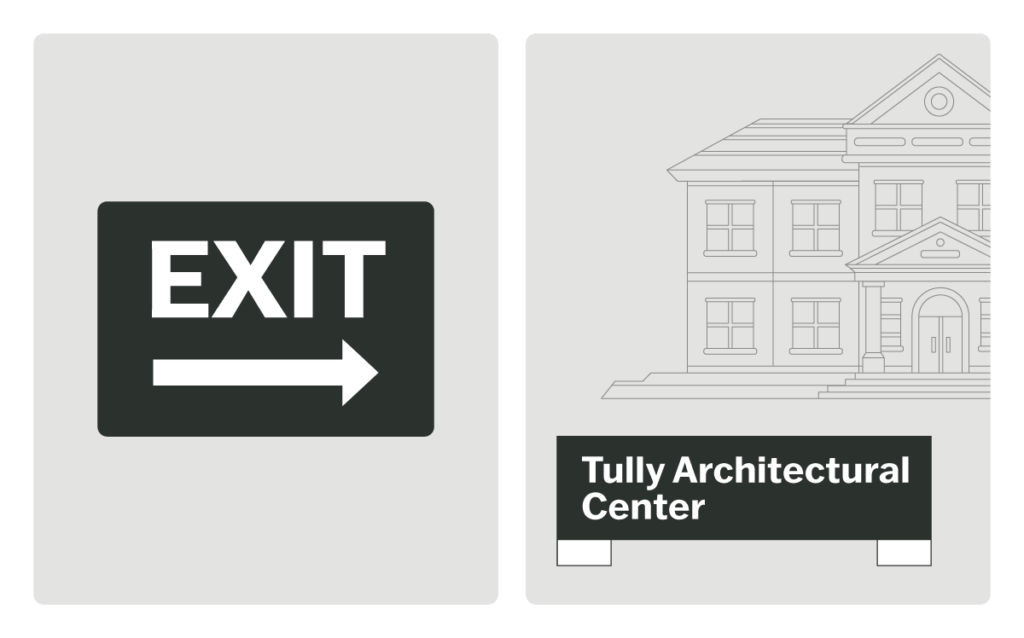
The ADA specifically lists exit doors, including doors at exit passageways, exit discharge, and exit stairways to be identified by signs. These signs must meet both visual and tactile requirements spelled out in section 703.
Entrances
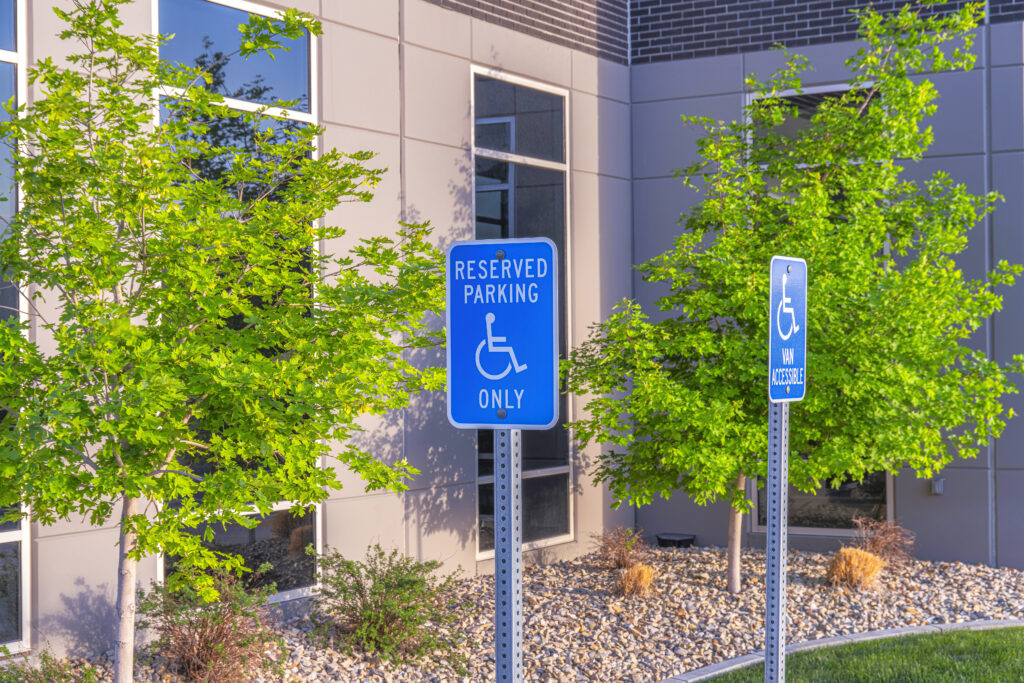
Two types of signs are required by the ADA at a building entrance, if not all entrances are wheelchair accessible (Section 404): A sign identifying the accessible, compliant entrance using the International Symbol of Accessibility (wheelchair symbol), and directional signs indicating the location of the nearest accessible entrance, posted at non-accessible entrances. These must meet the requirements for visual characters found in section 703.5
Elevators
Section 216.7 only specifies that if not all elevators are ADA compliant, that compliant elevators should be identified with the International Symbol of Accessibility. If all elevators are compliant, then no International Symbol of Accessibility sign is needed.
While elevators are only mentioned briefly in section 216, there’s a hidden sign requirement buried in section 407. Many of these 407 requirements are typically handled by the elevator fabricator during manufacture and installation, such as the requirement to have braille below elevator floor buttons. However the ADA requires two floor designation signs present at elevator hoistways. The language can be a bit confusing, but the intention is to clearly identify the floor you are currently on prior to entering or after exiting the elevator. Floor designation signs are required to have characters with a minimum height of 2 inches, and must include braille. They also must comply with section 703.2 and the standard mounting height in section 703.2.1, but not placement requirements. Since they are required to be 2 inches minimum, but also must comply with section 703.2 which sets character height at a maximum of 2 inches, the outcome is that these characters must be exactly 2 inches in height. Interestingly, although braille is specifically required, they are not required to comply with 703.3, which governs braille.
An additional car designation sign is required for destination-oriented elevators. Destination-oriented elevators are a specific type of elevator where riders choose their floor at a lobby control panel. The panel directs them to a specific elevator car. Each elevator entrance needs tactile car-identification characters and braille below the floor designation sign we just discussed. The tactile characters must be at least 2 inches high – and again they’re governed by section 703.2, so two inches is both the maximum and the minimum.
Toilets and Bathing Rooms (including showers)
If not all bathrooms, toilets or showers are ADA compliant, then the ADA requires directional signage that includes the international symbol of accessibility and meets the visual requirements portion (Section 703.5) of the ADA sign requirements. However if all of the toilets and bathing rooms in a facility are ADA compliant, no special signage is required.
Teletypewriters
Teletypewriters (TTY) are commonly used by those who are deaf or hard of hearing to send voice messages via a keyboard or text input. Public TTYs must be identified by the International Symbol of TTY. The ADA also requires that any banks of public payphones (not necessarily a single payphone) that do not have a TTY must provide a directional sign indicating the location of the nearest public TTY. These signs must also use the International Symbol of TTY. While payphones these days are rare, the 2010 ADA requirements still apply.
Volume-Control Telephones
Public telephones with volume control need a symbol that shows a telephone handset with sound waves on a square field. All public telephones are required to have volume control, so this applies to every public telephone.
Assistive Listening Systems
Assembly areas that must provide an assistive listening system must display a sign that tells people the system is available. The sign must include the International Symbol of Access for Hearing Loss and meet the visual requirements in Section 703.5. The sign may be placed at a ticket office or window instead of inside the assembly area, provided that they are displayed at each ticket office or window.
Check-Out Aisles
When a facility has more than one check-out aisle, each accessible aisle must display the International Symbol of Accessibility under Section 216.11. If aisles use a number, letter, or function label, place the symbol in the same location. Similar to restrooms and toilets, the rule does not apply when all check-out aisles that serve the same function (customers service versus standard checkout, for example) meet the ADA Standards.
Amusement Rides
An amusement ride with a queue must have a sign at the queue entrance that identifies the type of access available under Section 216.12. If an accessible unload area also serves as the loading area, identify that location at the queue entrance.
Assembly Seating
Wheelchair accessible or aisle seating designated for those with accessibility issues must have a sign or marker. These signs do not have to meet the tactile or visual requirements in section 703, though it’s advised that they be photoluminescent.
Transit Facilities
As you might expect, transit facilities have a lot of rules about signage, but these are mostly considered a separate category. There are some specific signs required: Each platform or boarding area must also have at least one tactile sign that identifies the station. And at least one sign at each rail-station entrance must include tactile characters under Section 810.6.
What Signs Are Exempt from the ADA Requirements?
Once you have determined that a sign is necessary to satisfy the requirements of the ADA, IBC, IFC, or local codes, or just as good wayfinding best practice, you need to determine what ADA requirements apply. Even in buildings that must meet ADA standards, there are some signs that the ADA recognizes that maintaining compliance would be too difficult of a burden or just not feasible. These signs are exempt and do not have to meet ADA requirements at all. There are also certain sign elements that are exempt from the ADA requirements, even if the rest of the sign’s elements are required to meet the standards.
These exempt signs or signs elements include:
-
- Certain signs and sign elements:
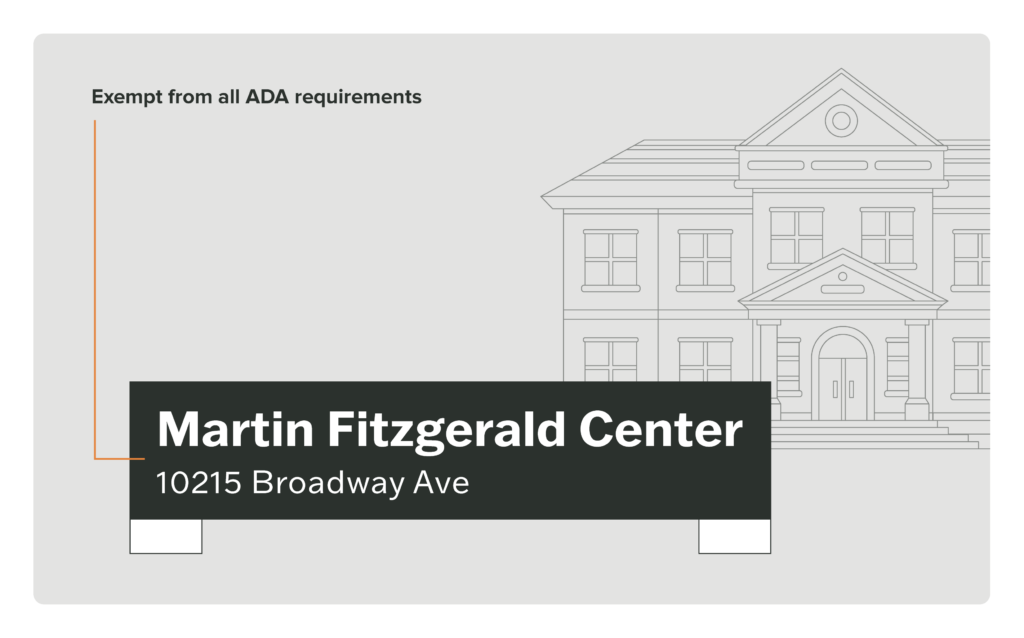
- Building addresses and directories,
- Occupant names, company names and logos,
- Menus,
- Building directories
- Parking facility signs: Most signs in parking facilities are exempt. The exceptions are signs for accessible parking spaces and signs required at exit stairways, exit passageways, and exit discharge. For example, a sign that identifies a stairway door in a parking garage must still meet the exit-sign rules.
- Temporary signs: Signs posted for seven days or less are exempt. This exception depends on how long a sign is posted, not what it is made of. A sign posted for more than seven days is no longer exempt. The rules then depend on the information the sign provides. For example, a sign that identifies a permanent room or space must meet the tactile sign rules.
- Signs in nonpublic detention and correctional areas: These signs are exempt from ADA sign rules.
- Certain signs and sign elements:
- Seats or row designations in assembly areas
Which Requirements Apply to Which Signs?
The actual ADA requirements for most signs (with elevators standing out as the exception) are found under section 703 and are separated into two subsections: visual requirements, and tactile requirements. Rarely if ever will you find a sign that is required to meet the tactile requirements and not the visual requirements, so in practice there are two groups: signs that are required to meet both visual and tactile requirements, and signs that are required to meet the visual requirements.
Visual Requirements Only
We’ll cover the specific visual requirements in a future article. For now, we’re only concerned with identifying which signs need to meet the visual requirements. Visual-only covers:
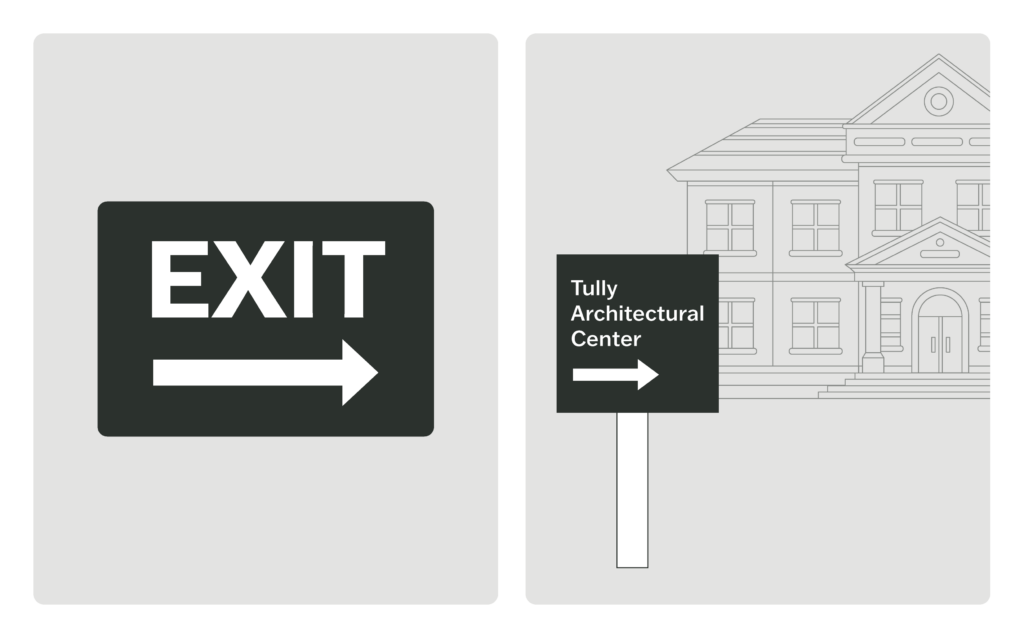
- Directional and informational signs, including arrows, hours, rules, and instructions.
- Area of refuge instruction signs
- Directional signage for accessible means of egress
- The directional and informational copy accompanying the ISA, TTY, and hearing loss symbols in 216.6 through 216.12, with the symbols themselves governed by
- Exterior signs that are not located at the door to the space they serve, for example a building identification sign.
Signs that need to meet visual and tactile requirements (raised characters and braille)
Some signs need tactile information as well as visual information. These include signs for permanent rooms and spaces and signs at exit stairways, exit passageways, and exit discharge. When the same letters provide tactile and visual information, some visual-sign rules that would conflict with the tactile character rules and mounting requirements do not apply. The ADA allows one sign with both visual and tactile information. It also allows separate visual and tactile signs. In either case, the tactile information must meet the rules for raised characters, braille, and mounting location under Section 703.
The following signs or sign elements must meet both visual and tactile requirements:
- Signs identifying permanent rooms and spaces (216.2)
- Doors at exit passageways, exit discharge, and exit stairways (216.4.1)
- Text descriptors accompanying pictograms that designate permanent interior rooms and spaces (216.2 and 703.6.3)
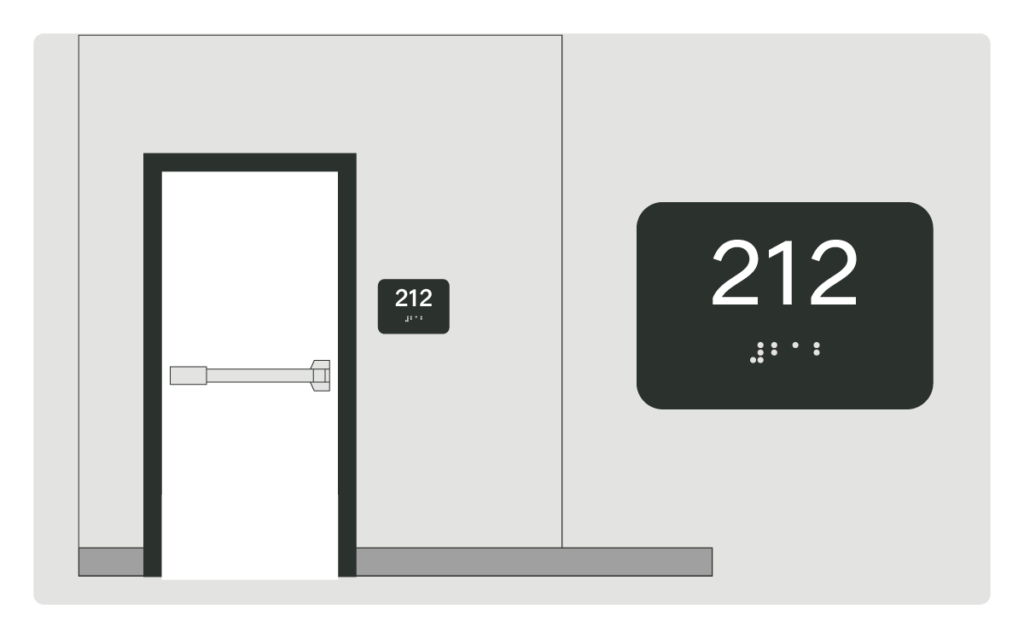
The first rule covers a lot. Any permanent room or space with a sign must meet both visual and tactile requirements. A permanent room or space has a name or number that is not likely to change. Examples include “STAIR 2,” “ROOM 314,” and “ELECTRICAL.”
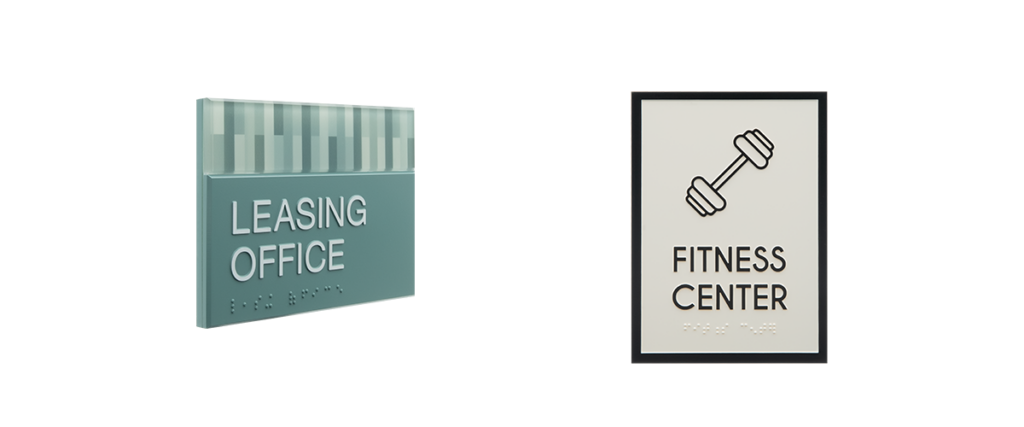
The third rule is interesting because at a glance it seems unnecessary. Couldn’t you just designate a room with a pictogram and not include text and still be compliant? No, you can’t. Architects can sometimes design minimalist signs where a graphic symbol, like stick figures for a restroom or a fork and knife for a cafeteria, serves as the primary room label. Section 216.2 specifically calls this out. If you have a pictogram that designates a permanent space, it also needs to have a text descriptor. That text descriptor needs to meet section 703.2 requirements, and section 703.2 contains a requirement for accompanying braille.
This rule is specific to pictograms that identify permanent spaces. Graphics that provide secondary context such as a “No Smoking” icon (informational), corporate logos (exempt), or the International Symbol of Accessibility (the wheelchair graphic) do not require tactile text descriptors.
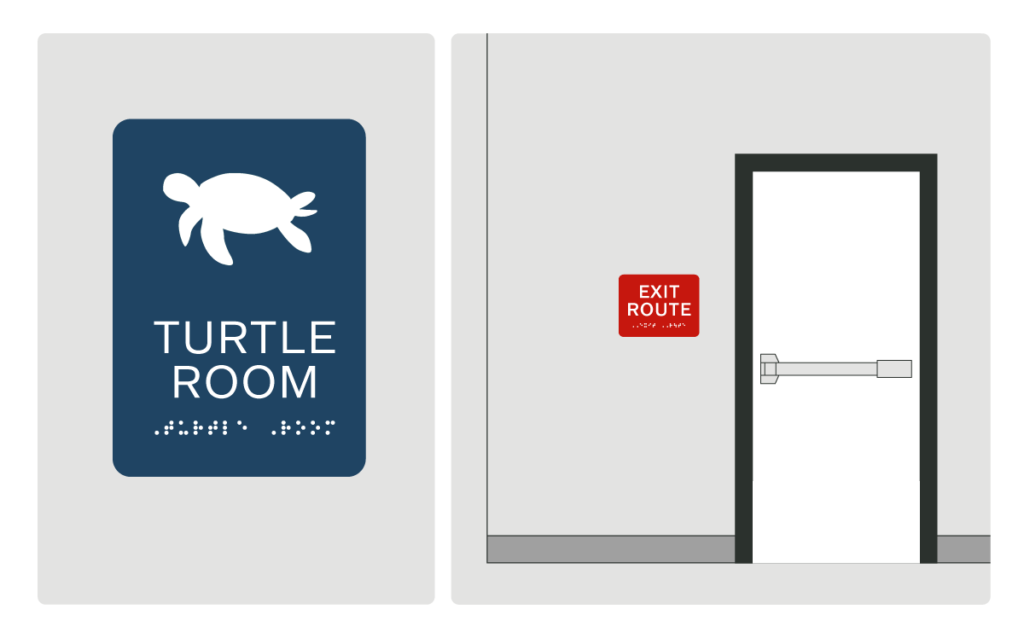
Again we can see a little of how the ADA works. Not all pictograms require text descriptors. However if the sign designates a permanent interior space, then there must be both tactile text and braille accompanying it. Since the conference room in the above example is identified by a pictogram, it must comply with section 216. Section 216 references section 703.2 on tactile text, which triggers the need for section 703.3 on braille.
Even on signs that designate permanent spaces, specific sign elements are not required to meet these same requirements. For example, an occupant’s name or title is specifically exempt. A department name is informational and must meet visual requirements. And an actual room number or room name triggers the need for tactile characters and braille. So rather than thinking “does this sign need to meet the ADA standards,” it’s better to think of the ADA and wayfinding signs in terms of individual sign elements: what elements are required on this sign, and what are the specifications those elements must meet?
What’s Next?
Knowing what signs you need and which signs need to meet which requirements is the first step. In our next article, we’ll cover the specifics of these requirements.
If you want to learn more, sign up for our ADA Webinar on Room Identification and Wayfinding Signage and earn 1 Health Safety and Welfare Learning Unit/CEU from the American Institute of Architects or the International Design Continuing Education Council (IDCEC).