If you’ve been thinking about adding equipment to your shop, the end of the year is the time! Q4 provides the shortest window between investing in equipment and recouping some (or all) of that expense via federal tax deductions. The tax code has two tools that let you write off equipment far faster than the old depreciate-it-over-seven-years approach. For 2026 both are unusually generous. Previously, Section 179 was the best tool available, but some fabrication shop owners may want to look at the new bonus depreciation rules as well. Both allow businesses to invest in equipment by saving some or all of that expense by deducting the cost from their taxable income. Here’s how they work:
Tax Tool #1: What Section 179 Allows
Section 179 lets businesses deduct the full purchase price of qualifying equipment and software in the year it’s placed in service, rather than depreciating it over several years. For tax year 2026, the maximum amount you can deduct is $2,560,000 of equipment. At a 21% tax rate, that’s a potential savings of up to about $537,600 in taxes… assuming you have a profit that large to deduct against. Most shops won’t come anywhere near that ceiling, and that’s fine. The point isn’t the maximum. It’s that the full cost of a realistic equipment purchase comes off this year instead of trickling off over the better part of a decade.
And don’t worry: although you can’t use Section 179 to run at a loss, if you aren’t able to deduct the full amount this year, the remainder carries forward. If you had $200,000 in income and $140,000 in operating expenses, and then purchase $80,000 of equipment, you can only deduct $60,000 in equipment this year. But the remaining $20,000 of equipment expenses carries forward to the next time you can use it. Operating expenses come out first, so that $60,000 cap is your profit after the everyday costs of running the shop, not your total revenue.
Section 179 can be applied to individual assets.
Tax Tool #2: Bonus Depreciation
Bonus depreciation is the standard method, and recent changes (the “Big Beautiful Bill Act”) have put it on parity with Section 179 for the business and given it some unique advantages for owners. Using bonus depreciation, a business can deduct 100% of the full purchase price with no dollar cap for equipment acquired and placed in service after January 19, 2025. Unlike Section 179, bonus depreciation can push a business into a loss.
That loss is where the advantage shows up for owners. If your company is an S-corp, LLC, sole proprietorship, or partnership, the loss flows through to your personal tax return, where it can offset other income you’re reporting.
Because there’s no cap and no income limit, bonus depreciation can deduct more than the business earned in a year, and that’s where the carryforward comes in that makes it comparable to Section 179, with some caveats. To reuse the same shop from the Section 179 example: say you have $200,000 in income, $140,000 in operating expenses, and an $80,000 equipment purchase. Section 179 would cap the deduction at the $60,000 of profit and carry the extra $20,000 forward. Bonus depreciation deducts the full $80,000 this year, which wipes out the $60,000 of profit and leaves a $20,000 net operating loss.
That net operating loss also carries into future years, with one limit: in any given future year, a carried-forward loss can offset up to 80% of that year’s taxable income. So if the shop earns $60,000 in taxable income again next year, the $20,000 loss can be applied against up to $48,000 of it, which easily covers the whole $20,000. Next year’s taxable income drops to $28,000, and the full deduction has been used, just spread across two returns.
Bonus depreciation must be applied to an entire class of assets. You’re not allowed to pick and choose individual assets.
For Both Tools, Timing Is Everything
If you want to take advantage of either deduction, now’s the time. For both of these tax deductions, the equipment needs to be placed into service by the end of the tax year, December 31st. That means installed and running, not just ordered or paid for. A machine that shows up January 2nd, or sits in a crate on New Year’s Eve, counts toward next year’s taxes instead of this one. If your plan depends on the write-off landing in 2026, give yourself enough runway for shipping and setup. So acting at the beginning of Q4 provides the quickest return on your investment, but requires fast implementation.
Federal Taxes Only
It’s worth noting that these methods only apply to federal taxes. State-level taxes vary by location, and many states don’t follow the federal bonus rules at all, so regular depreciation is typically still the standard method at the state level. That doesn’t reduce your federal benefit. It just means your state return may look different from your federal one, and your accountant will handle the split.
New, Used, or Leased
For the most part, how you acquire the equipment doesn’t change whether it qualifies. New equipment qualifies. Used equipment qualifies too, as long as it’s new to you and you’re not buying it from a related party. A used system from an unrelated seller like Nova Polymers gets the same first-year treatment as one straight off the factory floor.
Financing doesn’t disqualify you either, and this is the part that most people don’t realize. If you finance the purchase, you can still deduct the full price this year, not just the payments you’ve made so far. You could put a fraction down, finance the rest, and still write off the entire cost in year one. The deduction follows ownership and the placed-in-service date, not your payment schedule.
Leasing is the one case where the details matter. If your lease is really a purchase in disguise, the kind where you own the equipment at the end for a token buyout, it’s generally treated like a purchase and can qualify. A true rental lease, where you hand the equipment back when the term is up, doesn’t qualify for these deductions, because you never own it. In that situation you deduct the lease payments as a regular business expense instead. If you aren’t sure which kind of lease you have, that’s a one-minute question for your accountant.
Investing in Polymer
While modern flatbed 3D printers are quick and becoming cheaper all the time, polymer material will still have durability advantages over the layered acrylic or PETG construction used in these layer-based printed signs. Printed and built-up tactile characters and braille can wear, chip, or delaminate over time, especially on exterior signage that’s exposed to sun, salt, or humidity. Photopolymer locks the raised characters and braille into a single solid piece, so they stay intact and legible years after install.
That durability is also what lets these signs command a premium. Specifiers and building owners will pay more for signage that holds up over time, and raised characters and braille that resist wear are exactly what photopolymer delivers.
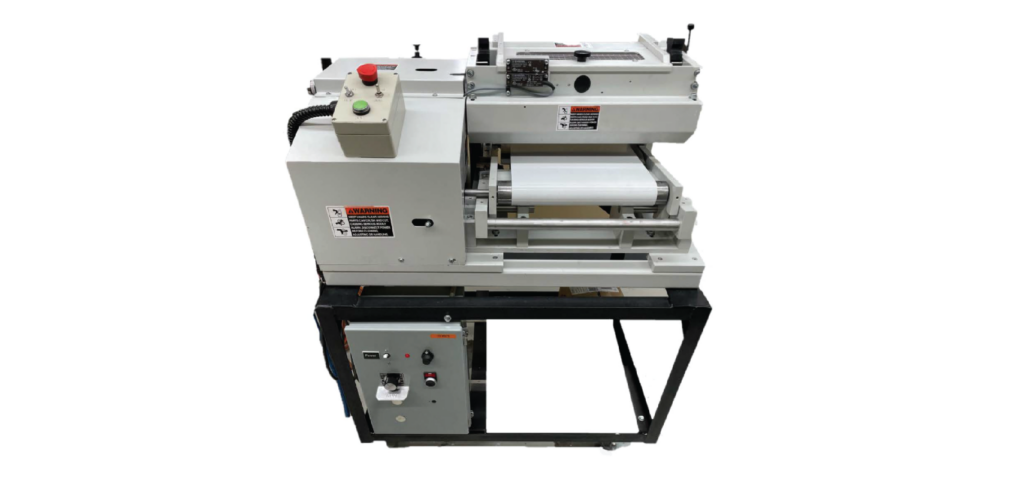
If you’ve been considering adding photopolymer to what your shop offers, the tax tools above make the end of the year a smart window to do it. Utilize tax incentives now to invest in a system that continues to produce quality, ADA-compliant signs. And since used equipment qualifies for the same first-year deductions as new, ask about our used equipment program to add polymer to your options at a discount.
This article is general information, not tax advice. Confirm the specifics for your business with your accountant or tax professional.