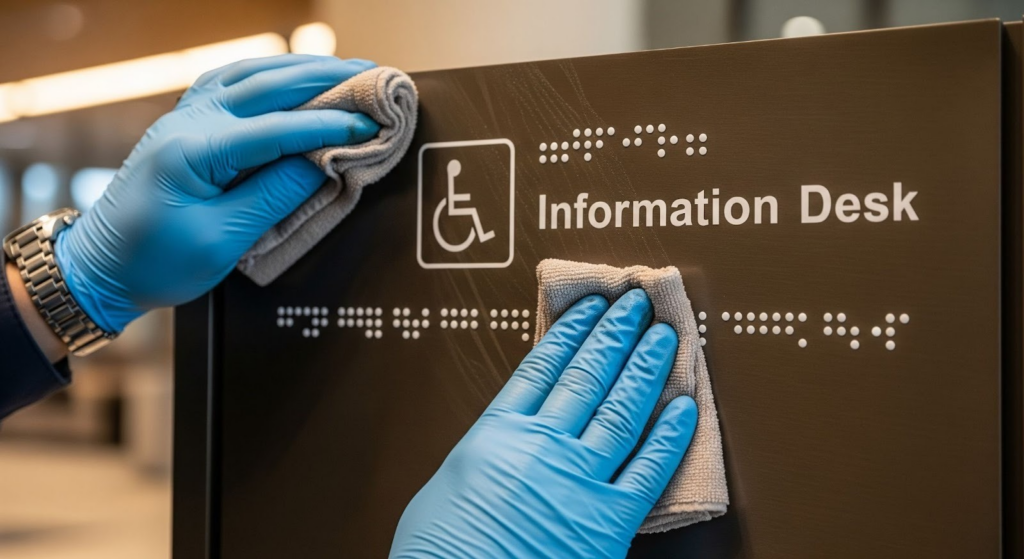
Healthcare architecture demands solutions that balance regulatory compliance, patient safety, and long-term performance. Chemical-resistant ADA signage in healthcare settings sits at this intersection, requiring architects to specify wayfinding systems that meet accessibility standards while withstanding rigorous antimicrobial cleaning protocols. The challenge is selecting materials and finishes that maintain ADA compliance under repeated exposure to hospital-grade disinfectants and harsh cleaning chemicals.
Understanding the Dual Requirements of Chemical-Resistant Healthcare Signage
Healthcare facilities operate under two distinct regulatory frameworks. The Americans with Disabilities Act establishes specific requirements for tactile characters, visual contrast, mounting heights, and surface finishes. Simultaneously, infection control protocols from the CDC and state health departments mandate frequent cleaning with powerful antimicrobial agents.
Traditional signage specifications often address these requirements separately, creating potential conflicts. A sign that meets ADA tactile character specifications at installation may lose dimensional accuracy after months of quaternary ammonium compound exposure. Color contrast ratios can shift when pigments degrade under bleach-based cleaners. Low-gloss finishes can become cloudy or reflective with repeated disinfection using harsh chemicals.
Architects specifying ADA signage for healthcare environments must ensure materials maintain compliance throughout their service life, not just at installation. This requires understanding how substrate materials, coating systems, and manufacturing processes provide chemical resistance to both accessibility requirements and antimicrobial cleaning protocols.
Material Selection Criteria for Chemical-Resistant Healthcare ADA Signage
The substrate forms the foundation of sign performance. Healthcare chemical-resistant ADA signage requires substrates with chemical resistance to dimensional changes under cleaning agent exposure, temperature fluctuations, and humidity variations common in medical facilities. Inferior materials may warp, swell, or contract when exposed to harsh chemicals, compromising tactile character accuracy and mounting stability.
Polymer substrates offer inherent advantages for healthcare applications. Unlike wood composites that absorb moisture or metals that corrode, engineered polymers maintain dimensional stability across environmental conditions. However, not all polymer signage performs equally under antimicrobial cleaning protocols.
Nova Polymers’ photopolymer substrates provide exceptional base stability, but the critical differentiator lies in surface protection. Unprotected polymer substrates can experience surface degradation from harsh cleaning chemicals, leading to color fading, finish changes, and tactile character erosion. Advanced polyurethane coating systems create a protective barrier that shields the photopolymer substrate while maintaining required surface characteristics and providing superior chemical resistance.
The Role of Polyurethane Coatings in Chemical-Resistant ADA Signage Performance
Polyurethane technology provides the chemical resistance necessary for healthcare environments subjected to frequent antimicrobial cleaning. These coatings form molecular crosslinks that create a resilient surface layer, protecting underlying materials from chemical attack. The crosslinked structure prevents harsh antimicrobial cleaners from penetrating to the photopolymer substrate, where they could cause swelling, discoloration, or structural degradation.
This protection extends to all critical ADA compliance features. Tactile characters maintain their required dome height and base diameter because the photopolymer substrate beneath the coating remains stable and protected from chemical exposure. Color pigments stay true because the polyurethane barrier blocks UV radiation and chemical oxidation from cleaning agents. The low-gloss finish specified by ADA standards persists because the coating surface doesn’t cloud or become glossy with repeated antimicrobial cleaning.
Beyond chemical resistance to cleaning agents, polyurethane coatings provide impact and abrasion resistance essential in high-traffic healthcare corridors. Equipment impacts, stretcher contact, and daily wear don’t compromise sign integrity, reducing maintenance costs and replacement frequency while maintaining the chemical barrier that protects against harsh disinfectants.
Specifying Performance Standards for Chemical-Resistant Healthcare ADA Signage
Architects should specify healthcare ADA signage with measurable performance criteria that address chemical resistance rather than generic material descriptions. Performance specifications ensure accountability and provide benchmarks for evaluating submittals against antimicrobial cleaning requirements.
Chemical Resistance Testing: Specify that signs must withstand exposure to common healthcare disinfectants, including quaternary ammonium compounds, sodium hypochlorite solutions, hydrogen peroxide-based cleaners, and alcohol-based sanitizers. Signs should maintain color stability, surface finish, and tactile character dimensions after repeated exposure cycles that simulate years of antimicrobial cleaning protocols.
Tactile Character Durability: Require that braille and raised character dimensions remain within ADA tolerances after simulated cleaning protocols with harsh chemicals. Character height, width, spacing, and edge definition should not degrade below specified thresholds despite repeated exposure to antimicrobial cleaning agents.
Color Contrast Maintenance: Specify minimum contrast ratios that must be maintained after chemical exposure and UV aging tests. Healthcare ADA signage must preserve visual accessibility throughout its service life, even under aggressive antimicrobial cleaning schedules.
Surface Finish Stability: The low-gloss finish required by ADA standards should remain consistent after cleaning cycles with harsh chemicals. Specify maximum gloss values that must be maintained to prevent problematic reflections that reduce readability, ensuring the coating’s chemical resistance doesn’t compromise surface appearance.
Impact and Abrasion Resistance: Healthcare environments are subject to physical stress. Specify impact resistance standards and abrasion cycles that signs must withstand without surface damage or tactile character degradation. This physical durability works in tandem with chemical resistance to ensure long-term performance.
Integration with Healthcare Wayfinding Systems
Chemical-resistant ADA signage functions within broader wayfinding systems. Architects must consider how material specifications affect system consistency, installation requirements, and future modifications in environments with rigorous antimicrobial cleaning protocols.
Material consistency across room identification signs, directional signs, and informational signs ensures uniform appearance and performance. Specifying a common photopolymer substrate and polyurethane coating system simplifies procurement, installation, and maintenance while ensuring all signs meet the same chemical resistance and performance standards.
Mounting systems for chemical-resistant ADA signage must accommodate substrate characteristics. Polymer signs with polyurethane coatings don’t require special mounting considerations beyond standard ADA compliance, but architects should verify that mounting hardware and adhesives are compatible with antimicrobial cleaning protocols and won’t degrade under chemical exposure.
Future modifications and additions should be considered during specification. As healthcare facilities evolve, new ADA signage must match existing installations in material, finish, and chemical resistance characteristics. Specifying well-established material systems like Nova Polymers’ photopolymer with consistent availability protects long-term wayfinding system integrity and ensures uniform performance under cleaning protocols.
Life Cycle Cost Considerations
Initial material costs represent only a fraction of total signage lifecycle expenses. Chemical-resistant ADA signage that withstands harsh antimicrobial cleaning agents reduces replacement frequency, labor costs, and operational disruptions.
Signs requiring replacement after failures from chemical cleaning create hidden costs. Facilities must purchase new signs, schedule installation during off-hours, manage workflow disruptions, and potentially face ADA compliance gaps during replacement. These costs far exceed any initial material savings from inferior products that lack adequate chemical resistance.
Durable, chemical-resistant ADA signage also supports sustainability goals. Extended service life under rigorous antimicrobial cleaning protocols reduces material waste and manufacturing impacts. When signs maintain their performance for decades rather than years despite harsh chemical exposure, the environmental footprint per year of service drops dramatically.
Partner with Nova Polymers for Chemical-Resistant Healthcare ADA Signage Solutions
Nova Polymers provides architects with advanced photopolymer substrates and polyurethane coating systems engineered specifically for healthcare environments requiring chemical resistance to harsh antimicrobial cleaning agents. Our ADA signage solutions meet stringent accessibility requirements while withstanding the most aggressive cleaning protocols.
Specify Nova Polymers for your next healthcare project and gain access to technical support, material testing documentation, and proven performance in demanding medical facilities with intensive antimicrobial cleaning schedules. Contact us to discuss your project requirements and learn how our chemical-resistant photopolymer ADA signage can enhance your wayfinding system’s durability, compliance, and lifecycle value under harsh cleaning conditions. Let Nova Polymers be your partner in creating healthcare environments that prioritize both accessibility and infection control through superior chemical resistance.